How to Survive Any Airport Layover

I spend a ridiculous amount of time thinking about airports.
Not necessarily because I love them—although some are pretty amazing—but because airports can make or break the beginning of a trip. A nice, easy connection and I’m happily wandering toward my gate. A delayed flight and a tight connection? Suddenly I’m sprinting through the terminal wondering why I didn't book the longer layover.
And yes...I’ve done the airport sprint more than once.
This September, I have 78 minutes in Vancouver to get from my domestic arrival gate to an international departure. Technically, it should be enough time.
Technically.
In reality, I already know there’s a pretty good chance I’ll be jogging through YVR.
Most of my international trips start at Victoria International Airport (YYJ), usually with a connection through Vancouver. Victoria is small enough that I know exactly where I’m going, and I’ve also flown through Nanaimo, which is even easier.
Then I arrive somewhere overseas where I have absolutely no idea where anything is.
That’s when things get interesting.
I’ve learned to research my connection airports almost as much as the cities I’m visiting. I look at terminal maps, baggage rules, transfer procedures, security requirements and how long it could realistically take me to get from one flight to another.
It sounds a little obsessive.
Okay...maybe it is.
But after layovers ranging from barely an hour to more than a full day, I’ve learned that a little planning can make airports a whole lot less stressful.
The Airport Sprint — Under 3 Hours
I normally try to give myself at least three hours between international flights, especially if I’m travelling through an unfamiliar airport.
Not because I want to spend three hours sitting at a gate, but because delays happen.
Security lines happen.
Immigration lines happen.
And sometimes the gate you need is approximately seventeen kilometres from where you happen to be standing. At least it feels that way.
I’ve had short connections where I’ve literally run between gates. Thankfully, I was travelling carry-on only because I’m fairly certain my checked bag would not have been moving quite as quickly as I was.
Airport maps are my friend with connections like this. If I can figure out ahead of time which terminal I’m arriving at, which terminal I’m leaving from and how I’m supposed to get between them, that’s one less thing to figure out while watching the clock tick down.
And then there’s airport food...
Airport food can be painfully expensive.
The most expensive airport lunch I’ve ever had was in Hong Kong, where lunch for my husband and me came to about $75 CAD.
Seventy-five dollars.
For airport lunch.
Ever since then, I try to have a few snacks tucked into my carry-on. I just make sure I know what I’m allowed to take into the country I’m visiting because meat, fruit and other fresh foods can cause problems at Customs.
I usually eat anything questionable before I land.
Problem solved.
Another thing I check is whether I can stay airside during my connection. Some airports require transit passengers to clear security again, and that can add a surprising amount of time.
I also pay attention to boarding time, not just departure time. Seeing "5:00 PM" on my ticket does not mean I can wander up to the gate at 4:58.
Especially for an international flight.
My upcoming 78-minute Vancouver connection is definitely shorter than I would normally choose. On my around-the-world trip,
I had another tight Vancouver connection and ended up running from the domestic terminal, through U.S. Customs and all the way to my gate.
I made it.
My stress level did not enjoy the experience.
My Sweet Spot — 3 to 6 Hours
Give me somewhere between three and six hours and I’m much happier.
For an international connection, this is probably my favourite amount of time. It gives me breathing room if my incoming flight is late, and I don’t immediately start panicking when I see a huge security line.
There is something very different about standing behind 200 people when I have four hours before my flight versus standing behind the exact same 200 people when boarding starts in 45 minutes.
This is also enough time for me to actually enjoy the airport.
I can wander through the shops, grab something to eat or head to a lounge if I have access.
My rule, though, is that I find my gate first.
I want to know exactly where I need to be before I disappear into a lounge on the opposite side of the terminal and get a little too comfortable.
Because nothing ruins a relaxing lounge visit quite like looking at the departure board and seeing FINAL BOARDING beside my flight.
Talk to somebody
One thing I started doing during my around-the-world trip was talking to people while I waited in long lines.
I’m not talking about starting deep conversations with complete strangers. Sometimes it was just a comment about someone’s bag, finding out someone was Canadian or discovering that another traveller had a connection just as ridiculous as mine.
I’m not naturally the person who chats with everyone around me, but I started thinking...I’m probably never going to see this person again.
So why not?
It made some very long airport lines a lot more enjoyable.
Find the showers
A longer connection is also a good time to see whether the airport—or one of its lounges—has showers.
After a long flight, a shower can feel ridiculously luxurious.
I had a two-hour layover in Auckland and happened to get pulled aside for additional screening. I mentioned to the Customs agent that I desperately wanted a shower and she told me there were public showers in the airport.
Perfect!
Except I didn't have a towel.
I ended up drying myself with paper towels.
Not glamorous. At all.
But after a long flight, I didn't care. That shower felt amazing.
Enough Time to Escape (6 to 12 hours)

Now it starts getting fun.
If I have somewhere between six and twelve hours and the airport isn't too far from the city, I start looking at whether I can leave.
There’s a huge difference between a six-hour layover and a twelve-hour layover, though, so I look at every airport individually.
I had an 11½-hour layover in Sydney and a 6½-hour layover in Dubai, and I left the airport during both.
In Sydney, I stored my backpack in a luggage locker so I didn't have to haul it around the city.
In Dubai, my larger bag was already checked through from Ho Chi Minh City to Nairobi, so I only had my day bag with me.
Much easier.
Luggage storage is one of the first things I look for when planning a long layover. I don't want to spend half a day exploring a city while lugging my backpack around with me.
I even used the same idea on a train trip through Europe. I had a ten-hour overnight connection in Brussels, so I booked a hotel near the train station that was also close to Grand Place.
Bed plus sightseeing.
Win-win.
Sometimes I stay put
Just because I have enough time to leave the airport doesn't mean I always do.
In 2019, I deliberately booked a 7½-hour layover in Hong Kong because I hoped to go into the city for a few hours.
Unfortunately, the student protests were happening at the time, and my travel agent recommended that I stay at the airport.
So I did.
My husband found a sleeping room.
I walked around the airport catching Pokémon.
I know how to make the best of a situation.
Had I known ahead of time that I wouldn't be leaving the airport, though, I probably would have booked a shorter connection.
That experience also taught me that I need to look at more than just how many hours I have. Safety, transportation, entry requirements and what’s happening locally all matter.
Don't Forget About Visas
A long layover doesn't automatically mean I can walk out of the airport.
I always check whether I actually have permission to enter the country.
Some countries make transit visits incredibly easy. Others require a visa or some type of electronic travel authorization before I arrive.
On my around-the-world trip, I used iVisa for several of my visas because I had quite a few countries to deal with and liked having everything in one place.
It was convenient...but convenience doesn't always mean cheapest.
I discovered that in Santiago when I was trying to check in for my flight to Sydney and realized at the last minute that I needed authorization to transit through Auckland, New Zealand.
I ended up getting a two-year visitor visa that cost me roughly $150 CAD more than the transit option I actually needed.
Ouch.
These days, I’m more likely to check the destination country's official government website first and then decide which application method makes the most sense for me.
Entry requirements change, so this is one thing I always check again shortly before I travel.
A Bonus Destination (12 to 24 hours)
Once a layover gets into the 12-to-24-hour range, I almost treat it like another destination on my trip.
Almost.
There is one very big exception...
Singapore Changi Airport!
I have a roughly 12-hour layover there later in 2026 and, for once, I’m actually planning on spending most of that time exploring the airport.
Because Changi is basically an attraction disguised as an airport.
For most other airports, though, I’d start looking at what I could realistically see outside the terminal.
The time of day makes a huge difference.
Give me a layover from 6:00 AM until 10:00 PM and I can do quite a bit.
Give me one from 10:00 PM until noon the next day and suddenly my sightseeing options aren't nearly as exciting.
For overnight connections, I also check whether the airline offers a hotel for long transit passengers.
On my first trip to Asia in 2015, I had a 26-hour layover in Guangzhou, China, and the airline provided a hotel room and transportation between the hotel and airport.
That was a very nice surprise.
Some airports and airlines also offer transit tours, so I always look into those before planning something myself.
Of course...planning it myself is also something I enjoy.
During my 2024 trip, I had a long connection in Ho Chi Minh City. I took a Grab into the city, explored on my own for a while and then had the driver take me to the meeting point for a food tour on the back of a scooter.
In Santiago, Chile, I took a taxi downtown, bought a hop-on hop-off sightseeing ticket, explored for a few hours and then took an Uber back to the airport.
Suddenly my layover became another travel day instead of several hours sitting beside a departure board.
I love that.
Airport Survival Kit
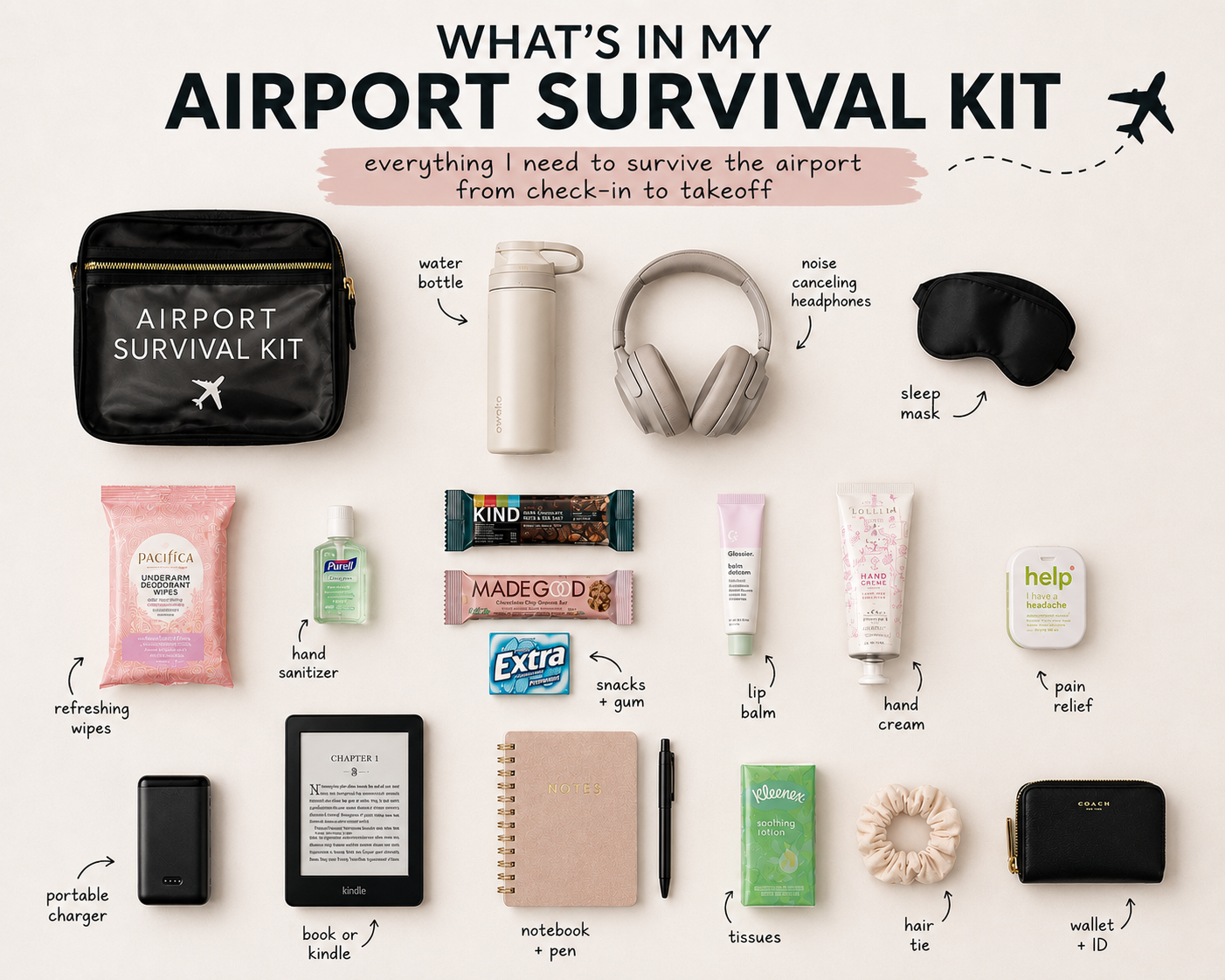
No matter how long my layover is, there are a few things I almost always have with me.
- - Empty water bottle — I fill it once I’m through security whenever there’s a filling station available
- - Charging cables — I make sure I can use both USB ports and regular electrical outlets.
- - Headphones — because nobody else in the airport wants to listen to whatever I’m watching.
- - A pen — immigration forms, notes, random things I suddenly need to write down...it takes up almost no space.
- - Downloaded airport maps — airport Wi-Fi isn't something I want to depend on when I’m trying to find my gate.
- - Offline Google Maps — especially useful if I’m leaving the airport during a long layover.
- - Google Translate with the local language downloaded — another thing I’d rather have and not need than need and not have.
- - Offline boarding passes — I usually take a screenshot so I'm not standing at security trying to load an app that suddenly refuses to cooperate.
- - Snacks — because I’m still not over that $75 Hong Kong airport lunch.
None of these things takes up much room, but they’ve saved me more than once.
Research the airport.
Seriously.
A 90-minute connection at a small airport might be perfectly comfortable. The exact same connection at a huge international hub could have me running through three terminals, clearing security again and questioning every decision that brought me to that moment.
Flight booking websites may let me book a connection because it meets the official minimum connection time.
That doesn't necessarily mean I want to book it.
There’s a difference.
My 78-minute Vancouver connection this September is a perfect example. I know YVR. I know where I’m arriving. I know roughly where I’m going. Both flights are booked as part of the same journey.
And I'm still expecting to run.
If I were looking at that same connection in an unfamiliar airport?
Nope.
I’d take the longer layover.
After all the airports, missed sleep, long lines, expensive meals, lounges, showers, luggage lockers and slightly ridiculous airport sprints I’ve experienced, I’ve learned one thing...
I would much rather have too much time than not enough.
And if I end up with a few extra hours?
I’ll find something to do.
I always do.